
Episodes / Episode 03
Episode 03 · November 2, 2026Anchoring
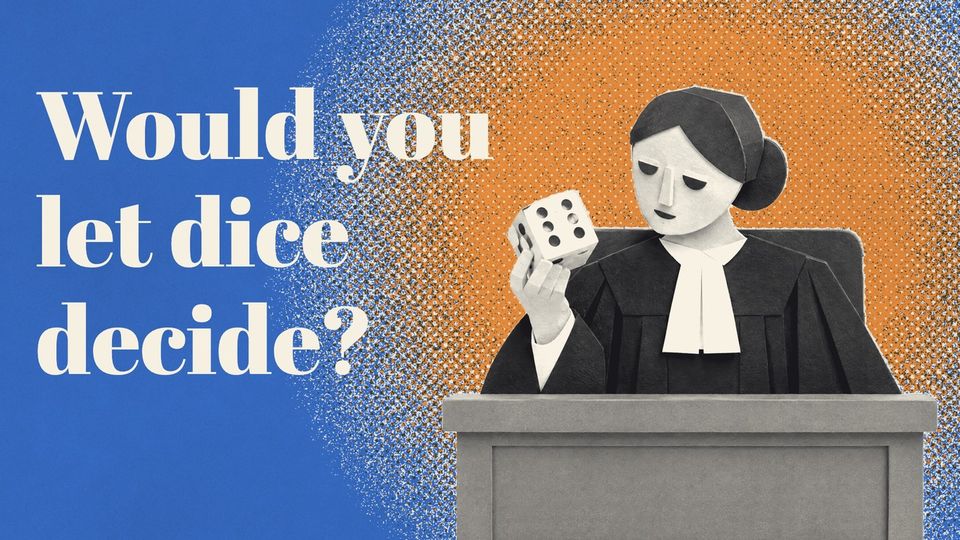
A Roll of the Dice Changed the Sentence
The first number you hear pulls your answer toward it, even when that number means nothing. Young lawyers who rolled a 9 on loaded dice gave longer sentences than those who rolled a 3.
What you can do
- Tested When someone hands you a number, come up with two reasons it's too high, or too low, before you answer.Two reasons cut the pull by about a third (Nagtegaal et al., 2020).
- Our suggestion If you can, write down your own number before you see theirs.Drawn from the findings, not tested on its own.
The studies
- Englich, Mussweiler & Strack (2006). Playing dice with criminal sentences. Personality and Social Psychology Bulletin 32(2), 188-200. doi.org/10.1177/0146167205282152
- Tversky & Kahneman (1974). Judgment under uncertainty: Heuristics and biases. Science 185, 1124-1131. doi.org/10.1126/science.185.4157.1124
- Kahneman (2011). Thinking, Fast and Slow, chapter 11.
- Klein et al. (2014). Investigating variation in replicability: A "Many Labs" replication project. Social Psychology 45(3), 142-152. doi.org/10.1027/1864-9335/a000178
- Wilson, Houston, Etling & Brekke (1996). A new look at anchoring effects. Journal of Experimental Psychology: General 125, 387-402. doi.org/10.1037/0096-3445.125.4.387
- Nagtegaal, Tummers, Noordegraaf & Bekkers (2020). Designing to debias. Public Administration Review 80, 565-576. doi.org/10.1111/puar.13211
- Klein et al. (2018). Many Labs 2. Advances in Methods and Practices in Psychological Science 1, 443-490. doi.org/10.1177/2515245918810225
- Critcher & Gilovich (2008). Incidental environmental anchors. Journal of Behavioral Decision Making 21. doi.org/10.1002/bdm.586
General education, not medical or psychological advice. Illustrations are stylized and don't show real people.